
Women fought for 157 years to take the oath of being a lawyer. Now someone wants to make it optional.
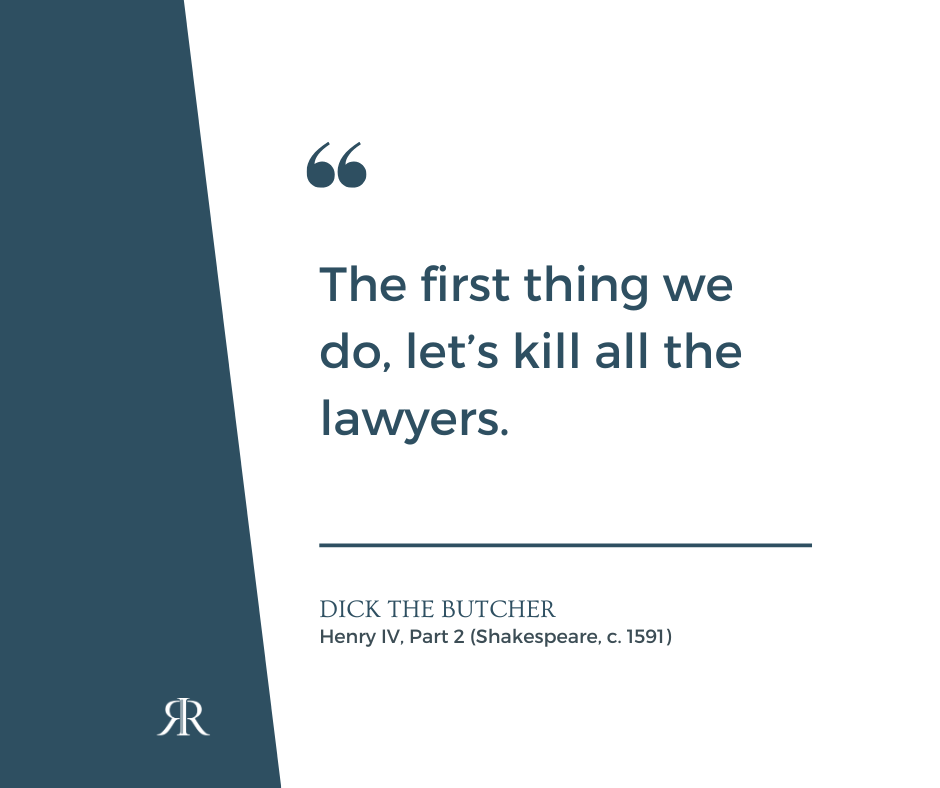
That line is almost universally misquoted and misunderstood. Dick the Butcher was not insulting lawyers. He was a follower of a would-be tyrant, and his point was strategic: if you want to seize power without accountability, you have to eliminate the people standing in your way. Lawyers, as officers of the court bound by ethics rules enforced by independent state bars, have always been exactly those people.
What makes lawyers that obstacle is not their intelligence or their persistence. It is their oath. When a lawyer is admitted to practice, she swears an oath to the court—not to a client, not to an employer, not to a party in power. This oath is the last thing you do as a lawyer to be able to practice law. That oath is enforceable by an independent body: the state bar. The bar is not a professional courtesy. It is the system that gives meaning to the oath.
Shakespeare wrote “let’s kill all the lawyers” 430 years ago. Yet, the threat has taken a quieter form: not eliminating lawyers, but removing the accountability structure that makes a lawyer’s oath enforceable.
As we close out March’s Women’s History Month at The Rudnicki Firm, we are questioning where women stand in the law, and what the profession is being asked to defend right now. This year, those two questions have the same answer. But first, we pay homage to those who fought for the ability to even take the oath.
Who Fought to Take the Oath: 1869 to Now
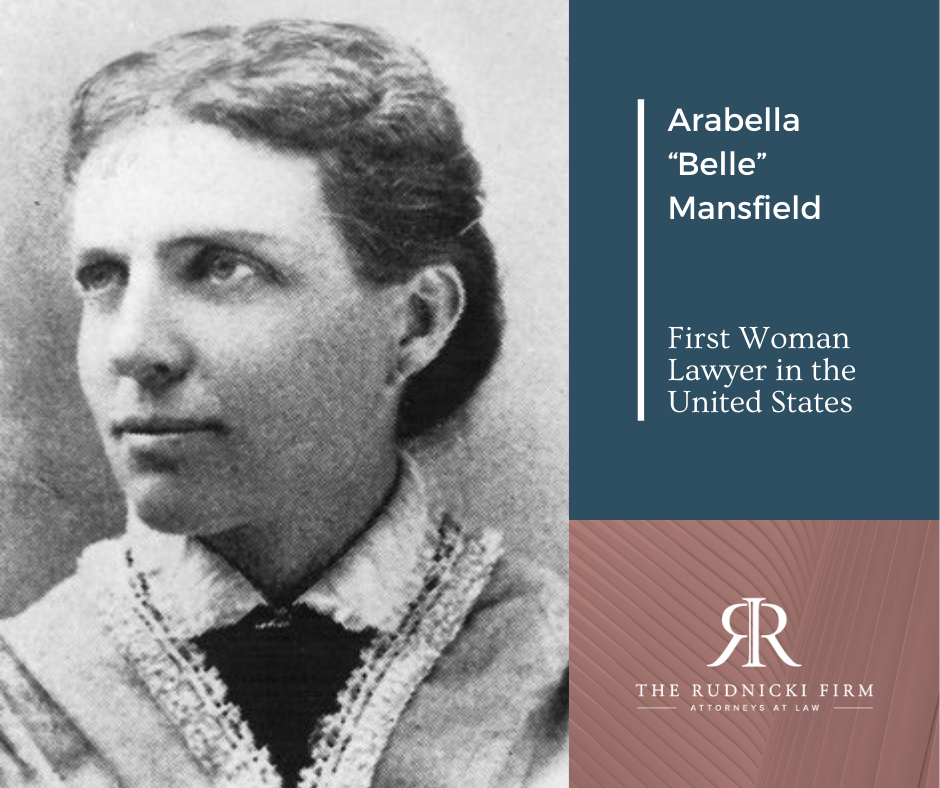
In 1869—the same year Arabella Mansfield became the first woman admitted to a state bar in the United States—John Stuart Mill published The Subjection of Women, arguing that the legal subordination of women was “a single relic of an old world of thought and practice exploded in everything else.”[1] He was wrong about one thing: it was not a relic. It was a foundation. The oath—and the standing to take it—was not available to women by default. It had to be fought for, case by case, bar by bar, state by state decade by decade.
The courts resisted at every turn. Three years after Mansfield’s admission in Iowa, the Supreme Court held that the “paramount destiny and mission of woman” was to fulfill “the noble and benign offices of wife and mother.”[2] That was the Court denying Myra Bradwell—who had passed the Illinois bar exam in 1869 and should have been licensed to practice law. The oath required, however, was unavailable to Bradwell. The Court simply refused to let her take it. As we documented in our March 2025 Spotlight on Women in Law[3] the milestones that followed came slowly:
1869 Arabella Mansfield — first woman admitted to a state bar (Iowa)
1869 Myra Bradwell — passed the Illinois bar exam; denied a license to practice by the U.S. Supreme Court
1879 Belva Lockwood — first female admitted to the United States Supreme Court Bar
1920 Florence Allen — first female to serve on a state supreme court (Ohio)
1925 Hattie Henenberg, Hortense Ward and Ruth Brazzil – first Texas All Woman Supreme Court[4]
1981 Sandra Day O’Connor — first female Justice of the United States Supreme Court
1982 Alma Bell Wilson — first woman on the Oklahoma Supreme Court; later its first female Chief Justice
Each of those milestones was a woman gaining access to the same oath, the same ethical obligations, the same room, the same accountability structure that men had taken since the oath was created.
In 1970, Shirley Chisholm—the first Black woman elected to Congress—published Unbought and Unbossed, naming the structural critique underneath a century of women’s legal history: that formal legal equality and practical powerlessness can coexist indefinitely, as long as the institutions that administer law remain insulated from the people the law is supposed to protect.[5] The women who fought their way to the bar understood that the oath was only meaningful if the institution enforcing it was independent. That is still the condition.
What the Oath Requires of Us Now
When a lawyer is licensed in Oklahoma, she swears to uphold the Constitution of the United States and the Constitution of the applicable states, to do no falsehood, to delay no person’s cause for lucre or malice, and to behave with integrity to her clients, with candor to the tribunal and public.
That oath is not administered by her employer. In Oklahoma, it is administered by the Oklahoma Supreme Court. Enforcement belongs to the Oklahoma Bar Association—not to the lawyer herself, and not to the entity that employs her.
This structure is not accidental. It reflects the foundational principle that no lawyer—however powerful her employer—is above independent ethical review. The state bar is the guardrail. The oath is only as meaningful as the independence of the body enforcing it.
The rule of law does not maintain itself. It is maintained by lawyers who take their oaths seriously, by bar associations that enforce those oaths independently, and by courts that hold the line between legal authority and raw power. When any one of those pillars weakens, the others bear more weight. History is consistent on this point: the erosion of professional accountability for lawyers who serve power is not a preliminary condition for authoritarianism. It is a feature of it.
Every lawyer admitted to practice in this country has made a promise to something larger than her client and larger than her employer. That promise is the line in the sand. It is not negotiable based on who signs your paycheck. It does not have a federal exception. It is the same oath whether you practice in in Oklahoma City, before the courts of Texas, in the federal district courts, or in the offices of the United States Department of Justice. A lawyer’s oath is not to be bought.
When the Government Comes for the Guardrail
If you can’t eliminate the lawyers, removing their ethical guardrails may serve Dick the Butcher’s strategy. Allowing lawyers to judge themselves. Stripping the independence from the accountability structure. That is what is happening at the Department of Justice in 2026.
On March 5, 2026, the DOJ proposed Rule OAG199, which would require state bar disciplinary authorities to suspend investigations into DOJ attorney misconduct and defer to the DOJ’s own internal review first.[1] Since the founding of the Republic, the regulation and discipline of attorneys has belonged exclusively to the states—a principle affirmed by the U.S. Supreme Court, every Circuit Court of Appeals, and Congress itself through the McDade Amendment in 1999. OAG199 does not eliminate state bar authority outright. It does something quieter and more corrosive: it insulates the government’s own lawyers from the timely, independent oversight that gives their oath its teeth.
One of the oldest principles of natural justice is nemo iudex in causa sua—no one may be a judge in their own cause. Madison wrote it into Federalist No. 10. Every lawyer understands it. It is why we recuse ourselves. It is why we do not sit on panels reviewing our own conduct. OAG199 asks us to set that principle aside for the attorneys who work for the federal government—the same attorneys whose ethical obligations run not just to their employer, but to the courts and the public they serve.
The women who spent a century fighting to take the bar oath did not fight for the right to be held to a lower standard than their male colleagues. They fought for the right to be held to the same standard—by the same independent body—as every other officer of the court. OAG199 moves in the opposite direction for everyone.
We are far from alone in that concern. As of March 30, 2026, more than 38,423 comments have been submitted on OAG199—a remarkable number for a federal rulemaking proceeding. We also want to acknowledge Liz Oyer, former DOJ Pardon Attorney, who has shown up nearly every day since her departure from the DOJ in 2025 to translate complex legal developments into clear, accessible information for the public. That commitment—especially under difficult personal circumstances—is what the oath looks like in practice.
The lawyers are still here. Many of us remain ready to hold the line and will stubbornly do so. Whether the current DOJ will do the same is a matter of public record—and public comment until April 6, 2026.
Thanks to the TRF team that put in the work to make our Objection worthy of filing as Officers of the Court.

THREE THINGS YOU CAN DO RIGHT NOW
1. Submit a comment opposing OAG199. The comment period closes April 6, 2026. Read The Rudnicki Firm’s formal public comment and submit your own at regulations.gov/commenton/DOJ-OAG-2026-0001-0001.
2. Follow Liz Oyer. Follow former DOJ Pardon Attorney Liz Oyer at @LawyerOyer for daily plain-language reporting on developments inside the Department of Justice.
3. Read the TRF Objection Submitted Opposing OAG199. See Leah T. Rudnicki & Addison Book, Comments and Objections to Docket No. OAG199 (March 24, 2026)
Leah Rudnicki is the founder of The Rudnicki Firm, a women-led litigation firm. She is licensed in Oklahoma, Texas, and multiple federal courts.
[1] John Stuart Mill, The Subjection of Women (1869) (Dover Thrift ed. 1997).
[2] Bradwell v. Illinois, 83 U.S. 130, 141 (1873) (Bradley, J., concurring).
[3] The Rudnicki Firm, “Spotlight on Women in Law” (May 16, 2025), https://www.rudnickifirm.com/newsroom/2025/5/14/spotlight-on-women-in-law-mental-health-awareness
[4] Texas Almanac, lasted visited 3/31/2026 https://www.texasalmanac.com/articles/the-texas-all-woman-supreme-court
[5] Shirley Chisholm, Unbought and Unbossed (1970) (Amistad Revival ed. 2010)
[6] Review of State Bar Complaints and Allegations Against Department of Justice Attorneys, 91 Fed. Reg. 43 (March 5, 2026) (to be codified at 28 C.F.R. § 77); AG Order No. 6653-2026-A; RIN 1105-AB82; 28 U.S.C. § 530B (McDade Amendment); The Federalist No. 10 (James Madison) (Library of Congress ed. 2019); Oklahoma Rules of Professional Conduct, Preamble (Okla. Sup. Ct. 2008).